
Table of Contents
The Indian car market is changing rapidly. With rising fuel prices and increasing awareness about environmental issues, more people are considering electric vehicles as their next car. However, one of the biggest questions buyers still ask is about the Electric Car vs Petrol Car Running Cost in India.
Is an electric car really cheaper to run than a petrol car? Or is it just marketing hype?
In this detailed guide, we will break down the real cost comparison between electric and petrol cars in India, including cost per kilometer, maintenance expenses, and long-term savings. By the end of this article, you will clearly understand which option makes more financial sense in 2026.
If you are planning to switch to an electric vehicle, it is also worth exploring the cheapest electric cars in India 2026. In recent years, several affordable EV models have entered the Indian market, making electric cars more accessible for everyday buyers who want to reduce their fuel expenses and running costs.
According to data from the International Energy Agency, global electric vehicle adoption is increasing rapidly as more countries shift toward sustainable transportation.
Electric Cars vs Petrol Cars – Understanding the Basics
Before comparing costs, it is important to understand how these vehicles work.
A petrol car uses an internal combustion engine that burns fuel to produce power. This technology has been used for decades and is widely available across India.
Electric cars, on the other hand, run on battery power. Instead of petrol or diesel, they use electricity stored in a large battery pack to power the motor.
Because of this fundamental difference, the Electric Car vs Petrol Car Running Cost in India varies significantly. Electricity is generally much cheaper than petrol, which directly affects the cost per kilometer.
If you want to understand how EV batteries perform in real Indian conditions, you can also read our detailed guide on EV battery life in India.
Electric Car Running Cost in India
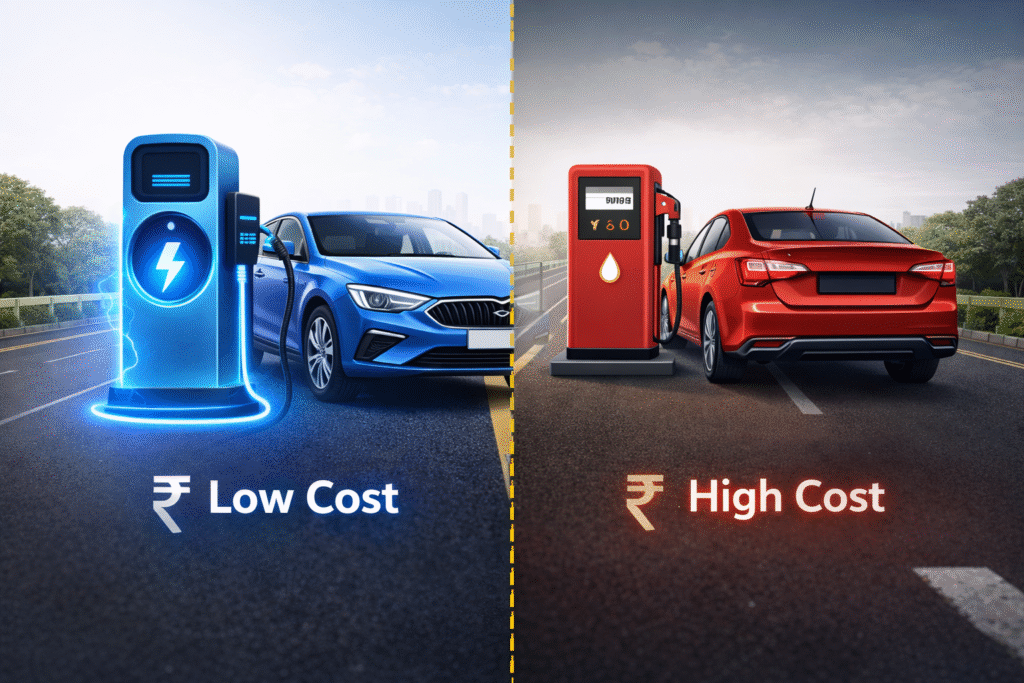
Electric vehicles are known for their low running cost, which is one of their biggest advantages.
The cost of running an EV mainly depends on three factors:
- Battery capacity
- Electricity price
- Driving range per charge
In India, the average electricity price for home charging ranges between ₹7 and ₹10 per unit depending on the state.
Let’s take an example.
Suppose an electric car has a battery capacity of 30 kWh. If the electricity price is ₹8 per unit, the cost of a full charge would be:
30 × ₹8 = ₹240
If the car can travel around 300 km on a full charge, the running cost becomes:
₹240 ÷ 300 km = ₹0.8 per km
This is where the Electric Car vs Petrol Car Running Cost in India becomes interesting. The cost per kilometer of an electric vehicle can be less than ₹1, which is significantly lower than petrol cars.
Another factor to consider is the electric car charging cost in India, which may vary depending on whether you charge at home or use a fast charging station.
Petrol Car Running Cost in India
Petrol cars are still the most common vehicles on Indian roads. However, their running cost is much higher compared to EVs.
As of 2026, petrol prices in many Indian cities are around ₹100 to ₹110 per litre.
Let’s calculate the cost per kilometer for a petrol car.
Assume a car gives a mileage of 15 km per litre.
If petrol costs ₹105 per litre, then:
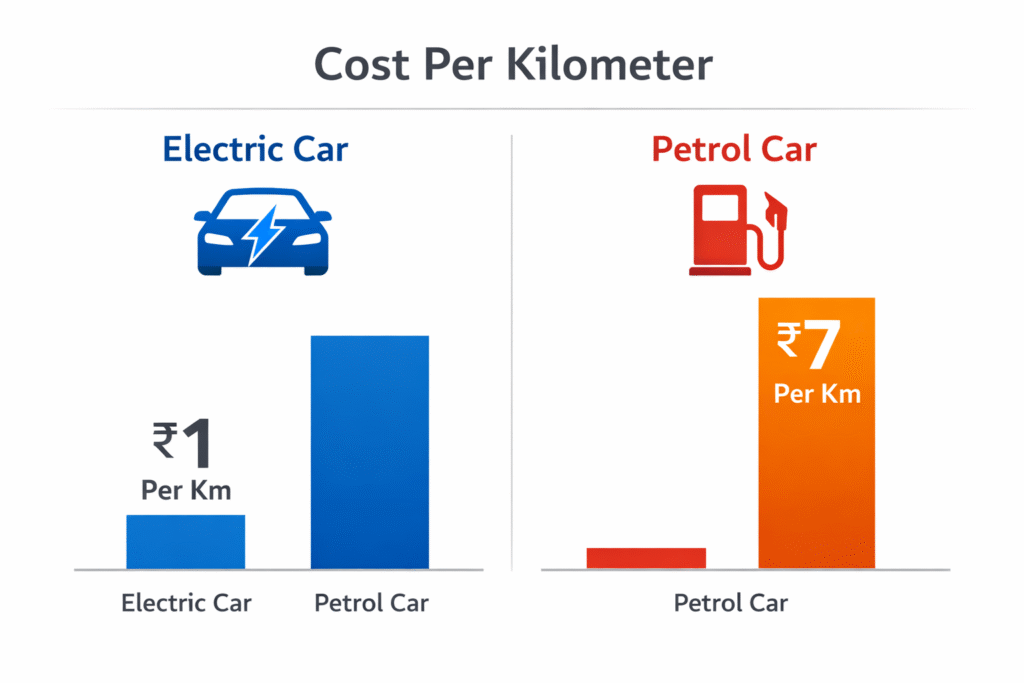
₹105 ÷ 15 km = ₹7 per km
So the running cost becomes approximately ₹6 to ₹7 per kilometer.
This huge difference clearly shows the impact when comparing the Electric Car vs Petrol Car Running Cost in India. In many cases, EVs can be up to 6–7 times cheaper to run.
This is why many people searching for ev vs petrol car cost comparison india are surprised when they see the actual numbers.
Electric Car vs Petrol Car Cost Per Kilometer
To make things clearer, let’s look at a simple comparison table.
| Vehicle Type | Average Running Cost Per KM |
|---|---|
| Electric Car | ₹0.8 – ₹1.5 |
| Petrol Car | ₹6 – ₹8 |
From this comparison, it becomes obvious that the Electric Car vs Petrol Car Running Cost in India strongly favors electric vehicles when it comes to daily driving expenses.
Even if electricity prices increase slightly, EVs still remain significantly cheaper to operate.
Maintenance Cost Comparison
Running cost is not the only factor to consider. Maintenance expenses also play a major role in long-term ownership.
Electric vehicles have far fewer moving parts compared to petrol cars. They do not require many of the regular services that petrol engines need.
Typical EV maintenance includes:
- Brake inspection
- Tire rotation
- Software updates
- Battery health checks
Petrol cars require much more frequent maintenance, such as:
- Engine oil changes
- Oil filter replacement
- Air filter replacement
- Spark plug replacement
- Clutch and gearbox servicing
Because of these additional components, the Electric Car vs Petrol Car Running Cost in India over time becomes even more favorable for electric vehicles.
This is one of the reasons why people researching electric vehicle running cost india are increasingly interested in EVs.
5-Year Running Cost Comparison
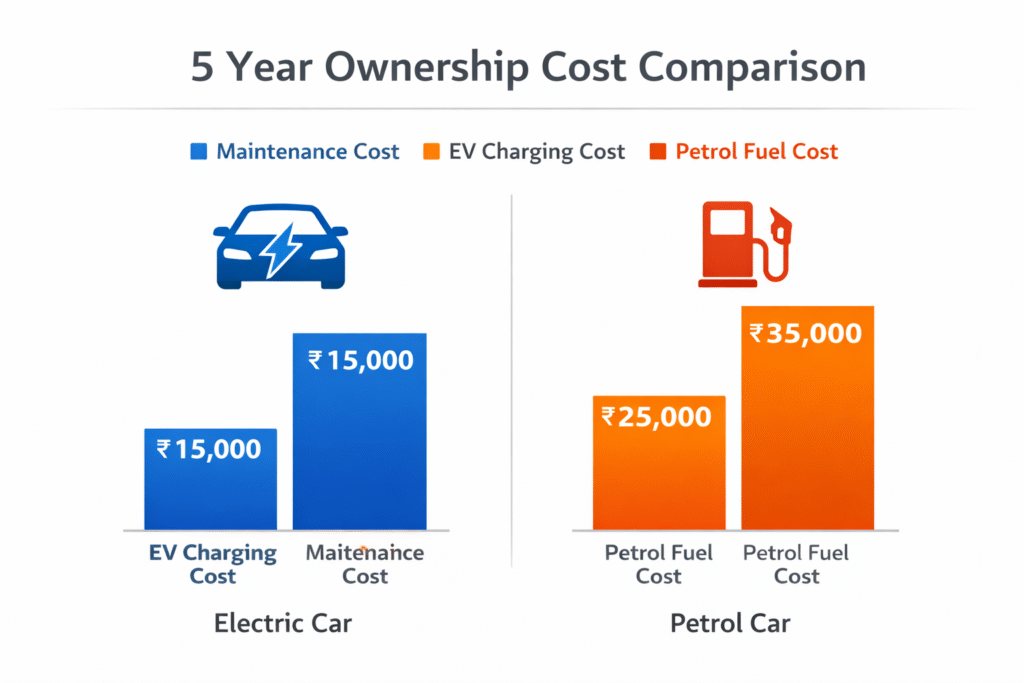
To understand the real financial impact, let’s compare the estimated cost of owning an EV and a petrol car for five years.
Assume the car is driven 12,000 km per year.
Electric Car
Running cost per km: ₹1
Annual running cost:
12,000 × ₹1 = ₹12,000
Five-year cost:
₹60,000
Maintenance estimate:
₹25,000 – ₹30,000
Total five-year cost:
₹85,000 – ₹90,000
Petrol Car
Running cost per km: ₹7
Annual running cost:
12,000 × ₹7 = ₹84,000
Five-year cost:
₹4,20,000
Maintenance estimate:
₹70,000 – ₹90,000
Total five-year cost:
₹4,90,000 – ₹5,10,000
When you analyze the Electric Car vs Petrol Car Running Cost in India, the difference over five years can be several lakhs.
This is exactly why many buyers searching for ev vs petrol car cost comparison india are now leaning toward electric vehicles.
Advantages of Electric Cars
Electric cars offer several benefits beyond just lower running costs.
Lower Fuel Expenses
Electricity is significantly cheaper than petrol, making EVs more economical for daily use.
Smooth Driving Experience
Electric motors provide instant torque, resulting in smooth and silent acceleration.
Environment Friendly
EVs produce zero tailpipe emissions, which helps reduce air pollution.
Low Maintenance
Since EVs have fewer mechanical parts, they usually require less maintenance.
These advantages strongly influence the Electric Car vs Petrol Car Running Cost in India over the long term.
Advantages of Petrol Cars
Despite the benefits of EVs, petrol cars still have some advantages.
Lower Initial Price
Petrol cars usually have a lower purchase price compared to electric vehicles.
Easy Refueling
Petrol stations are available everywhere in India, making long trips more convenient.
Better Highway Range
Petrol cars can travel long distances without worrying about charging infrastructure.
These factors still play an important role when evaluating the Electric Car vs Petrol Car Running Cost in India for different driving needs.
Which Option Is Better for Indian Buyers?
Choosing between an electric car and a petrol car depends on your usage.
If most of your driving is within the city and you have access to home charging, an EV can save you a significant amount of money.
However, if you frequently travel long distances or live in an area with limited charging infrastructure, a petrol car might still be a practical option.
Understanding the Electric Car vs Petrol Car Running Cost in India helps buyers make a smarter decision based on their daily driving habits.
Before buying an EV, it is also important to check details like EV battery warranty in India, because battery replacement can be expensive if not covered.
The actual running cost of an electric vehicle also depends on electricity rates and charging methods. Understanding the electric car charging cost in India can help buyers estimate how much they will spend on charging their vehicle at home or at public fast-charging stations.
Conclusion
The comparison between electric and petrol cars has become one of the most discussed topics in the Indian automobile market. After analyzing the numbers, it is clear that the Electric Car vs Petrol Car Running Cost in India heavily favors electric vehicles.
Electric cars offer extremely low cost per kilometer, lower maintenance expenses, and long-term savings that can reach several lakhs over five years.
Petrol cars still remain a practical option for certain situations, especially for long highway trips and buyers who prefer a lower upfront price.
However, as charging infrastructure improves and battery technology advances, electric vehicles are likely to become the more economical choice for most Indian car buyers in the coming years.
As electric vehicles continue to grow in popularity across India, more buyers are now exploring different EV options based on their budget and needs. Whether you are looking for advanced features, long driving range, or a budget-friendly option, the Indian EV market now offers many choices. If you want a premium electric vehicle with more space and performance, you can explore the Best Electric SUV in India 2026. On the other hand, buyers with a tighter budget can check the Best Electric Car Under 15 Lakh in India, where several affordable EV models offer great value for money while still delivering low running costs and modern features.